

The best tools for affiliate marketing in 2026 combine automated content creation with SEO optimization and conversion-focused formatting. We've tested the leading platforms to identify which ones actually drive affiliate revenue, not just churn out generic blog posts.
Your choice hinges on three factors: product review quality, ranking speed, and integration with your existing workflow. Some platforms excel at listicles but fail at in-depth comparisons. Others produce authoritative reviews but lack keyword research capabilities.
Below, we'll break down the top contenders by use case—whether you're scaling a niche site, launching a new affiliate program, or optimizing existing content for better conversions. Each tool gets evaluated on output quality, SEO performance, and real-world ROI.
Why Every Affiliate Needs an AI Content Generator Today
Okay, let’s be real for a second. Look, the days of spending three whole days writing one "Best running shoes" article are long gone.
Your competitors are publishing daily. Speed is not just a luxury anymore.
It is a survival metric.
An effective ai content generator does more than just put words on a page. It acts as a research assistant.
It analyzes the top-ranking pages for your target keywords.
It creates outlines based on what Google currently favors.
Then, it fills in the gaps with data.
But there is a catch.
Google’s algorithms are smarter than ever. They're all about "Experience, Expertise, Authoritativeness, and Trustworthiness" (what we all know as E-E-A-T). Just asking a simple chatbot to "write a review" is a good way to get penalized.
You need tools that were actually built for marketers.
What you need are tools that get *intent*. When someone is typing "best CRM for small business" into Google, they're not just browsing—they're ready to buy.
Your content has to match that commercial intent. It needs to have things like comparison tables. It absolutely needs a pros and cons section and a clear verdict.
This is where most standard AI tools fall flat, and where specialized affiliate tools really start to shine.
The right piece of software can turn you into a product review machine, but without the burnout.
It gives you back the time to focus on the big picture—strategy, negotiating partnerships, and building those crucial links. And speaking of strategy, bringing AI into your workflow means you can finally test out more niches.
Instead of gambling your entire month on a single topic, you could launch content for four different clusters and see what actually takes off.
That is the power of volume combined with precision.
How AI Content Generators Actually Work
Most people think an ai content generator is just a fancy autocomplete. Wrong. These systems run on transformer-based neural networks — the same architecture powering tools like content generation ai tools — trained on billions of text samples to predict what comes next in a sentence. They don't "understand" your topic the way a human does. They recognize patterns. Feed them a prompt, and they calculate the statistically most probable continuation based on everything they've absorbed during training.
Here's what happens under the hood. The model breaks your input into tokens (chunks of text), converts them into numerical vectors, then runs those vectors through layers of attention mechanisms that weigh which words relate to which. If you ask for "best hiking boots for winter," the AI doesn't Google that phrase. It pulls from pre-trained associations between "hiking," "boots," "traction," "insulation" — patterns it learned from millions of outdoor gear reviews, forum threads, and product descriptions. That's why an ai article writer can draft a coherent product comparison without ever owning a single boot.
Training Data and Pattern Recognition
Specialized content tools differ from chatbots in one crucial way: fine-tuning. A generic chatbot trains on everything. A purpose-built content generator trains on filtered datasets — blog posts, landing pages, product descriptions — then gets fine-tuned on conversion-focused examples. That's the gap between "write me an article" and "write me a 2,000-word affiliate review that ranks." Tools like RobotSpeed vs Copy.ai for SEO exploit this difference by analyzing competitor content and search intent, then steering the output toward what actually ranks in 2026.
The machine learning layer continuously adjusts weights based on feedback loops. Some systems scrape top-ranking pages for your keyword, extract semantic patterns, and inject those into the generation process. Others fine-tune on your brand voice by learning from your existing content. Either way, the goal is the same: mimic the statistical fingerprint of high-performing text without copying it verbatim.
Top AI Content Generators for 2026
We have tested the market leaders. We looked at how they handle affiliate marketing content, their ease of use, and whether they actually save you time. So, here's our definitive list for this year.
1. RobotSpeed: The Complete SEO Autopilot
We're putting ourselves at the top, not out of ego, but because we've solved the one huge problem that other tools don't address. Most AI generators write text and stop there.
But text doesn't rank without authority. RobotSpeed is the only ai content generator that combines high-level content creation with an automated backlink network.
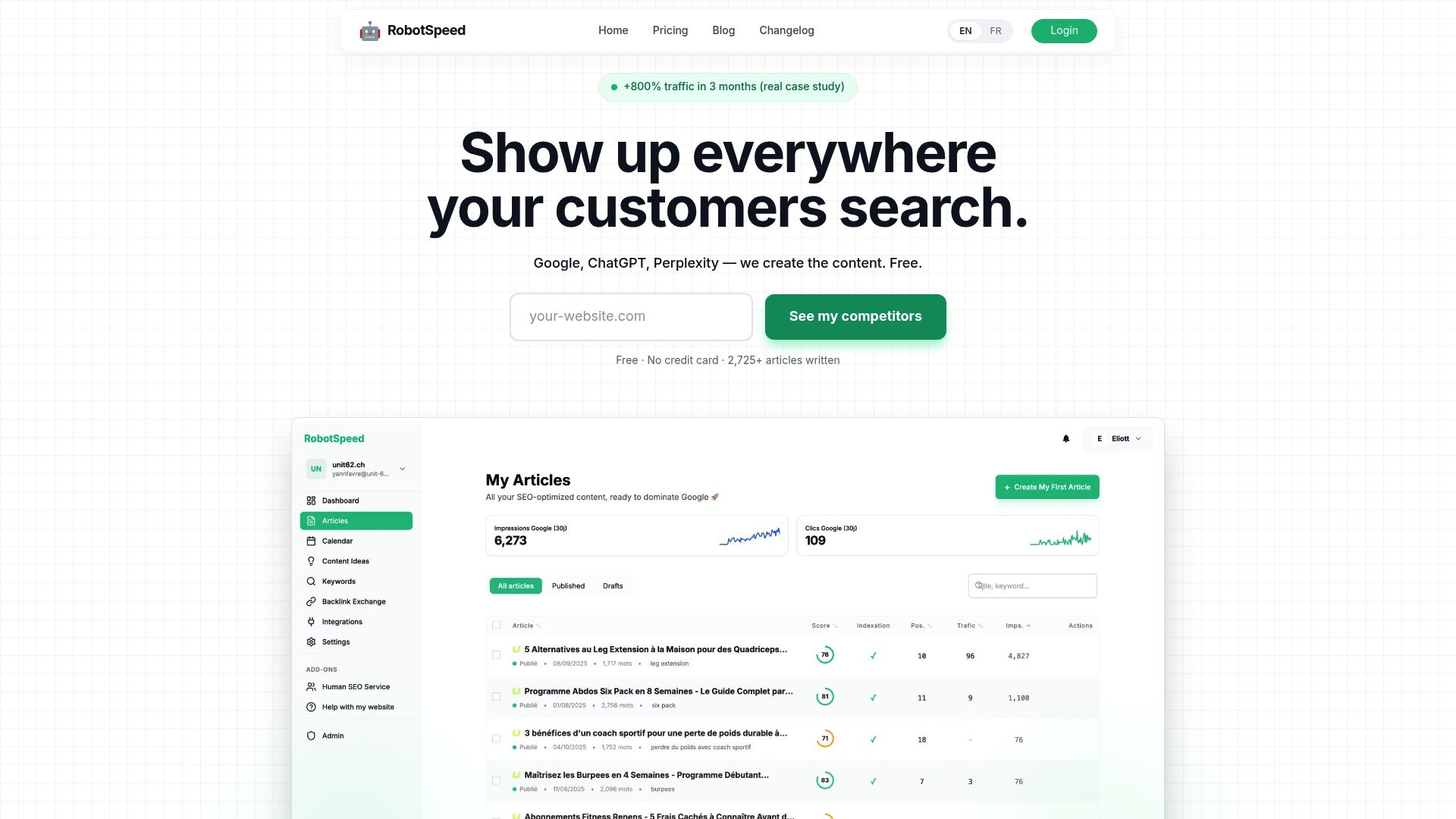
For a subscription of $99 CHF/month, we don't just give you an article. Our AI Content Agent digs up sources, crafts content designed to read like a human wrote it, and then our system automatically starts building backlinks to that new post. It's this all-around approach that helps our users see results significantly faster than they would with old-school manual SEO.
What sets us apart is the automation of the entire workflow. The research, the writing, one-click publishing to WordPress or Shopify, and even the link exchanges. It's built from the ground up for businesses and agencies that are serious about ranking, not just filling pages with text.
Our content engine analyzes top-ranking pages for your target keywords, identifies semantic gaps, and produces articles that match search intent while maintaining natural language flow. The interface requires minimal input — you provide the keyword, we handle the rest.
2. Jasper AI: The Marketer's Veteran Choice
Jasper has been a major player in this field for a long time. It's well-known for its "Boss Mode" and a whole library of templates made specifically for writing marketing copy.
If your goal is to create branded product reviews, Jasper is a solid choice.
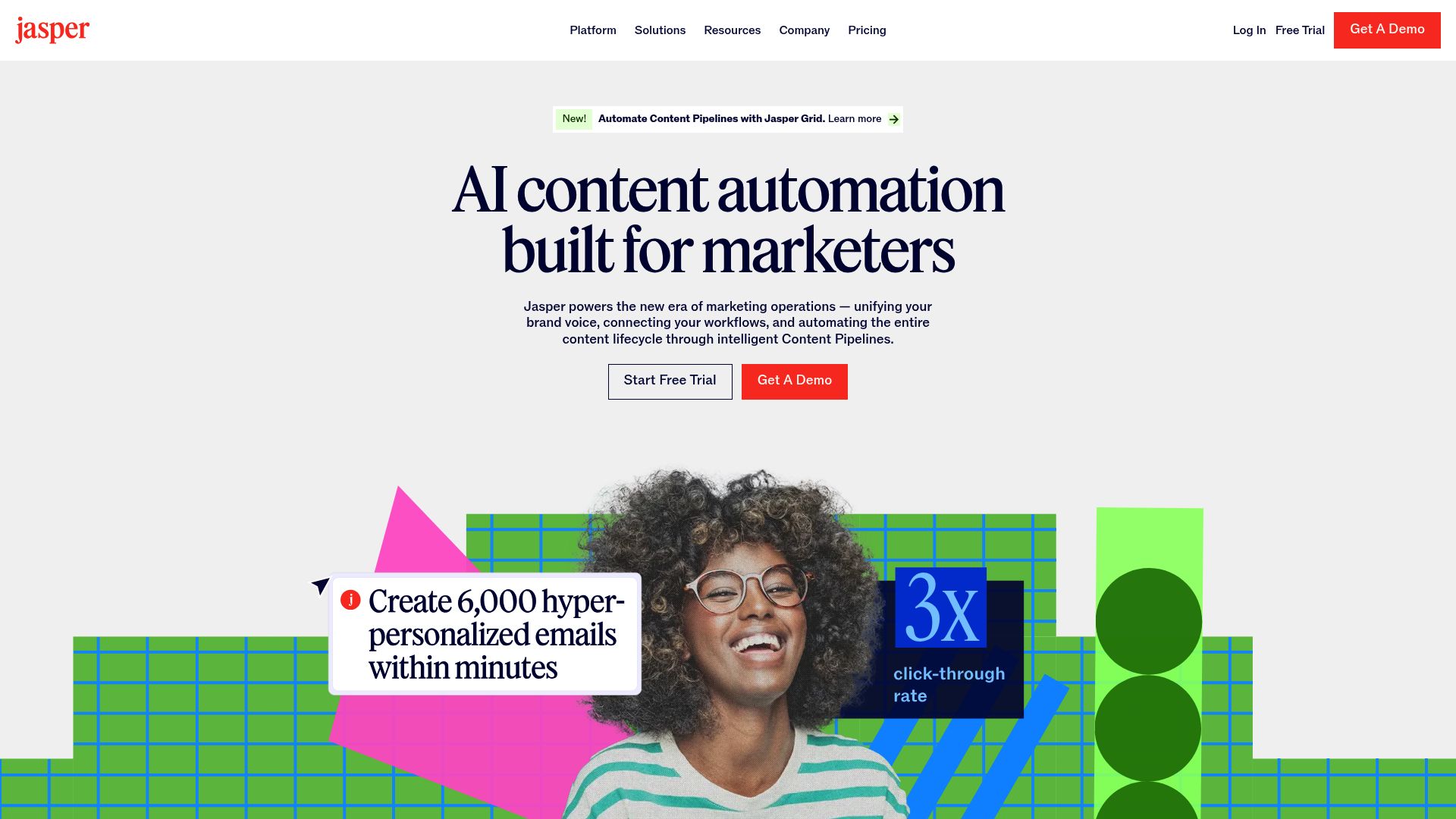
According to recent reviews from Vibelets, Jasper excels at creating listicles and comparisons because it offers pre-built templates specifically for these formats. You can plug in product features, and it'll generate a structured list of benefits. For affiliates, their "One-Shot Blog Post" workflow is useful, though it often requires heavy editing to sound human.
It also handles multiple languages, which is valuable if you're trying to reach international audiences. The pricing kicks off at about $59 a month, positioning it as a mid-range option.
A big selling point for Jasper is that it integrates with Surfer SEO (though that's an extra cost), which helps with on-page optimization. The tool's strength lies in marketing copy rather than technical SEO implementation. You'll get polished ad copy and email sequences, but the platform doesn't automate link building or technical SEO tasks that independent content tools require.
3. ChatGPT (OpenAI): The Versatile Engine
You really can't discuss AI writing without addressing the elephant in the room.
ChatGPT, especially the Plus version at $20 a month, is actually the engine that powers a lot of other tools on the market.
📸 openai.com
For an affiliate marketer, it's remarkably versatile.
It's fantastic for brainstorming different angles for your content.
You can tell it to "act like a skeptical buyer" and have it come up with common objections to a product you're writing about. Doing this helps you write reviews that feel more balanced and trustworthy.
The catch, as noted by Hostinger's analysis, is that ChatGPT requires skill in "prompt engineering."
Right out of the box, the content it generates can be bland and repetitive. Worse, it has a troubling habit of "hallucinating" facts, which is a disaster for product reviews. If you're going to use ChatGPT, you absolutely have to fact-check every single spec and price. Think of it as a raw engine, not a polished, all-in-one solution. But for whipping up ad copy or quick social posts, you really can't beat it for the price.
4. Writesonic: The Specialist for Current Events
Writesonic has gotten attention for its "Chatsonic" feature, which can actually connect to the internet and pull in real-time information. This matters significantly for affiliates who review tech products, where specifications can change almost overnight.
If you're trying to write a "Best Smartphones of 2026" post, you can't work with training data that's two years old. Writesonic bridges that information gap effectively. PropellerAds highlights its ability to generate long-form blogs with current data.
Its interface is easy to navigate, and it even has specialized tools for crafting Amazon product descriptions.
So if a big chunk of your affiliate revenue comes from Amazon Associates, Writesonic has effective templates that excel at outlining features in clear bullet points. The platform's strength is staying current, though it lacks the comprehensive SEO automation that enterprise-grade solutions provide.
5. Copy.ai: The Short-Form Specialist
While Copy.ai *can* write blog posts, where it really shines is with short-form content. We're talking email newsletters, captions for social media, and those snappy intros for your product reviews.
For most affiliates, the email list is where the real money is made anyway.
They have a generous free plan, which makes it an accessible way to test AI writing without committing any cash. But when it comes to those deep, research-heavy articles that need solid SEO structure, you'll probably find it's lightweight compared to a comprehensive platform like RobotSpeed or even Jasper. The tool excels at generating multiple variations of the same message, perfect for A/B testing email subject lines or ad copy.
Feature Comparison: Choosing Your Tool
To make things a little clearer, we've put together a breakdown of how these tools compare for the specific needs of an affiliate marketer.
| Tool | Best For | Pricing (Approx) | Key Affiliate Feature |
|---|---|---|---|
| RobotSpeed | Full Automation (Content + SEO + Backlinks) | $99 CHF/mo | Auto-publishing & Link Building Network |
| Jasper AI | Branded Reviews & Templates | See official pricing | Marketing-specific templates |
| ChatGPT Plus | Brainstorming & Ad Copy | See official pricing | Versatility & Coding help |
| Writesonic | News-based Articles | $20+/mo | Real-time data access |
| Copy.ai | Social Media & Emails | Free / See official pricing | High volume short-copy |
Strategy: How to Use an AI Content Generator for Reviews
Having the tool is only half the battle.
You need a strategy.
The most profitable content for affiliates is the "Product Review." This is "Bottom of the Funnel" content.
The reader is ready to buy; they just need a nudge.
When using an ai content generator, do not just say "Write a review of X." The result will be fluffy praise that readers hate. You need to structure your prompts or settings to produce a balanced analysis.
The "Pros and Cons" Necessity
Readers do not trust perfect products. If your AI-generated review is nothing but glowing praise, you might get the clicks, but your conversion rate is going to tank. People will just leave.
You have to make sure your AI tool can create a "cons" section. This is something we specifically trained RobotSpeed’s AI Content Agent to do—it finds those important nuances.
It actually scans forums and user reviews to pick up on genuine pain points, which makes the content it generates feel like it was written by someone with real, hands-on experience.
The Comparison Table
Google loves tables. Readers love tables. They provide a quick snapshot of data.
When you are writing a "Best X vs Y" post, ask your AI to generate the data in a CSV or Markdown table format.
This increases engagement time on the page. Tools like Jasper can do this well, provided you give them the correct data points to compare.
The goal is to be the most useful resource on the internet for that specific query.

Scaling with Listicle Content
Listicles (think "Top 10 AI Tools") are pretty much the bread and butter for any affiliate marketer. They let you target those high-traffic keywords and promote a bunch of different products all in one article. Naturally, this ups your chances of earning a commission.
The big challenge with listicles, though, is just the sheer amount of writing involved.
Trying to write 10 unique mini-reviews is completely draining. An AI content generator is the perfect solution because it lets you standardize the format.
You can just set a simple structure like: "Intro + Features + Pricing + Best For," and then let the AI run with it for each product on your list. This keeps your article consistent, which makes it way easier to read.
And keeping things consistent is crucial for holding a reader's attention.
But you still have to inject your own voice.
The AI gives you the skeleton and the muscle, but you're the one who adds the personality.
Add a personal anecdote in the introduction.
Add a specific recommendation in the conclusion. This "human touch" is what builds trust.
The SEO Factor: It Is Not Just About Words
You can have the best content in the world, but if nobody sees it, you make zero dollars.
This is where the intersection of AI and SEO becomes critical. Writing is only 20% of the job.
The other 80% is optimization and off-page authority.
Optimizing for Search Intent
A strong AI writing tool should weave keywords naturally, avoiding old-school "keyword stuffing" tactics. Instead, it should deploy semantic variations—related terms that give Google better context.
For instance, an article about "affiliate marketing content" should naturally incorporate terms like "conversion rates," "CTA placement," and "recurring commissions." This semantic richness signals topical expertise to search engines. Google's 2024 Helpful Content Update penalizes thin, repetitive text while rewarding comprehensive coverage of user queries.
As discussed extensively on Linkxo, the integration of AI into SEO strategies is redefining how we approach ranking.
The content must be technically sound but also rhetorically convincing to satisfy both the algorithm and the human.
The Role of Backlinks
This is the hard truth most AI tool providers hide: Content alone rarely ranks for competitive keywords. You need backlinks. Think of them as votes of confidence from other websites.
The usual way to get them involves sending out thousands of cold emails, basically begging for a link.
It's soul-crushing work, honestly.
And that's the exact bottleneck we built RobotSpeed to eliminate. Our Premium Link Network actually comes with your subscription.
So when you publish an article through RobotSpeed, you're not just throwing text onto your site—you're plugging into an ecosystem that automatically starts boosting your Domain Authority. No more cold emails.
Advanced Tactics: Using AI for Local and Niche Affiliates
Affiliate marketing isn't just for big software companies or global brands. There's a goldmine of potential in local service niches and super-specific industries.
Just imagine an affiliate site that's all about comparing insurance policies or vetting local service providers.
For example, if you're running a site that compares rental insurance, you've got to have really deep, comparative content. Setting up a "comparative guide" structure is absolutely key. You can see great examples of how human-written sites do this on pages like LouerAppartement's guide about choosing borrower insurance.
An AI tool can copy that same structure, breaking down all the data points from different policies and laying them out clearly for the reader.
Content even matters for super-local niches, like emergency locksmiths. It might not seem obvious, but even a locksmith's website needs blog posts to rank for searches like "price of lock change" or "home security upgrades." A site like Serrurier Kad, for example, could use AI to whip up helpful articles about home security trends, which in turn builds trust and authority for their actual services.
The formula never really changes: helpful content leads to traffic, and traffic leads to conversions.
Overcoming the AI Detection Fear
A big worry I hear from affiliates is, "Will Google penalize me for using AI?" The answer is a little complicated.
Google has come out and said they don't really care *how* content is made, as long as it's genuinely helpful for the user.
However, low-effort AI content is often classified as "spam." If you just copy-paste from ChatGPT, you are at risk.
This is why using a sophisticated product review writer tool is better.
Drafting for "Human" Quality
Tools like RobotSpeed are built with bypassing detection in mind.
We use varied sentence structures, perplexing vocabulary, and non-linear logic patterns that mimic human thought. This isn't about tricking Google; it is about keeping the reader engaged.
We avoid the monotonous rhythm that basic LLMs (Large Language Models) produce. Human writing has bursts of short sentences. Then long, complex interactions of ideas.
Then a question?
AI usually writes in medium-length, flat sentences.
Varied pacing keeps the reader's eye moving down the page. And the longer they stay on the page (Dwell Time), the better your SEO signals are.
Building a Sustainable Workflow
To make $99+/month on tools worth it, you need a workflow that produces ROI. Here's the workflow we recommend for 2026:
- Keyword Research: Use RobotSpeed or Ahrefs to hunt down those low-competition keywords with clear buying intent.
- Automated Briefing: Let the AI handle the briefing by analyzing the top 10 competing articles for your target query.
- Generation: Generate the first draft, making sure the tool automatically pulls in stats, cites sources, and creates data tables for you.
- Human Polish: Take 15 minutes for a human touch-up. Add a personal story, check the tone, and make sure your call-to-action is solid.
- Visuals: Use an AI image generator to create unique visuals—Google definitely prefers them over generic stock photos.
- Publish & Link: Click publish to push it to your CMS and kick off the automated backlink campaign.

kenny cheng / Unsplash
This kind of workflow completely changes your role from a writer to more of an editor-in-chief. You’re no longer just digging ditches; you're the one designing the city.
The Cost of Action vs. Inaction
Investing in a premium ai content generator might feel like just another expense on the books.
But calculate the cost of your time. If it takes you 4 hours to write a good review, and your time is worth even $50/hour, that one article cost you $200.
With a tool like RobotSpeed, that time drops to 15 minutes. The subscription pays for itself after the first article of the month. The rest is pure profit margin expansion.
In the low-margin game of affiliate marketing, efficiency is your biggest lever.
Conclusion: The Future is Automated
The affiliate marketing space is becoming more competitive, not less.
Big publishers are entering your niche. To compete, you must leverage technology. The "manual grinder" mentality is noble, but it is not scalable.
Whether you choose Jasper for its templates, ChatGPT for its raw power, or RobotSpeed for its all-in-one SEO automation, the key is to start now.
Every single day, the gap widens between affiliates who are using AI smartly and those who are still trying to do it all by hand.
We built RobotSpeed specifically to give mid-sized businesses and affiliates that an unfair advantage. We take care of all the heavy lifting—research, writing, and ranking—so you can focus on what matters: watching those commission payments roll in.
Ready to spend less time writing and more time ranking?
Take a look at how our AI Content Agent can completely change your affiliate business, starting today.
Frequently Asked Questions
Will using an AI content generator torpedo my SEO rankings?
Nope, as long as the content is high-quality, factually correct, and actually helps the reader. Google goes after low-quality, spammy stuff, and it doesn't care if a human or a robot wrote it. Tools like RobotSpeed are built specifically to produce valuable content that ticks all of Google's quality boxes.
Can AI write good product reviews?
Yes, but only if it has the right data to work with. A specialized product review writer AI can analyze technical specs and what real users are saying to create a genuinely balanced review.
That being said, adding your own photos or a few personal thoughts always goes a long way in building trust.
Is the investment in a paid tool worth it over free ChatGPT?
If you're running a business, the answer is a definite yes. Free tools demand a ton of careful prompting, fact-checking, and tedious formatting. Paid tools like RobotSpeed or Jasper give you entire workflows, built-in SEO optimization, and ready-to-go templates that can save you hours on every single post.
In the world of affiliate marketing, the time you save is money you earn.
How often should I publish affiliate content?
Consistency is everything. If you're writing manually, cranking out 1-2 posts a week is a solid pace.
With AI automation, you can easily jump to 5-7 high-quality posts a week, which will massively speed up your traffic growth.
Do I still need to build backlinks if I use AI?
high. Backlinks are still one of Google's top 3 ranking factors, and that hasn't changed. AI can write the content, but you still need to build authority.
That’s exactly why we include an automated backlink exchange network with every RobotSpeed subscription—it solves both problems at the same time.
FAQ - Frequently Asked Questions
How do AI content generators actually work?
They analyze patterns in massive text datasets, then predict word sequences that match your prompt. Think of it like autocomplete on steroids—the model learned from billions of sentences how certain topics typically unfold, what structure makes sense, which phrases connect ideas naturally.
When you feed in a brief or keyword, the system doesn't "understand" meaning the way humans do. Instead, it calculates probabilities: after "benefits of renewable energy," what word or phrase is statistically likely to come next?
That's why outputs sometimes feel formulaic—the model gravitates toward common patterns it saw during training.
What are the main benefits of using AI content generators?
Speed tops the list. A task that used to take hours—drafting product descriptions, email campaigns, blog outlines—now wraps up in minutes.
You also dodge writer's block. Even when your brain stalls, the tool churns out structure and ideas you can refine. And for teams juggling multiple projects, AI scales content production without hiring additional writers.
What features should I look for in an AI content generator?
Template variety matters more than most people realize. A tool with pre-built frameworks for ads, emails, landing pages, and social posts saves you from starting with a blank canvas every time.
Look for tone adjustment controls—professional, casual, persuasive—so you can match different brand voices. Multi-language support helps if you serve international markets.
Version history and editing tools are underrated. The first draft rarely nails it; you want an interface that makes tweaking painless. Integration with your existing workflow (CMS plugins, API access) prevents friction when rolling out content at scale.
Are there any limitations to AI content generators?
Accuracy isn't guaranteed. The model occasionally invents plausible-sounding facts that don't exist—dates, statistics, product specs—so you must fact-check anything mission-critical.
They struggle with deep expertise. A tool trained on general web text won't match a domain specialist's nuance in fields like legal compliance, medical advice, or technical engineering. Use AI for the scaffolding, then layer in human knowledge.
Brand voice consistency takes work. Out of the box, most generators default to a neutral, slightly corporate tone. Reaching your unique voice requires custom prompts, examples, or fine-tuning—which means upfront investment before the output truly sounds like you.